Pacemaker Implantation in Dehradun
Being told you need a pacemaker often comes as a surprise — it’s not something most people expect to hear, and the word itself carries more worry than the procedure usually deserves. This page explains what a pacemaker actually does, who needs one, how it’s implanted, and what daily life looks like afterward, so you can go into a consultation with a clearer picture instead of just the word itself.Dr. Richa Sharma is an Interventional Cardiologist practicing in Dehradun, evaluating and implanting pacemakers for patients with slow or irregular heart rhythms.
What Is a Pacemaker and Who Needs One?
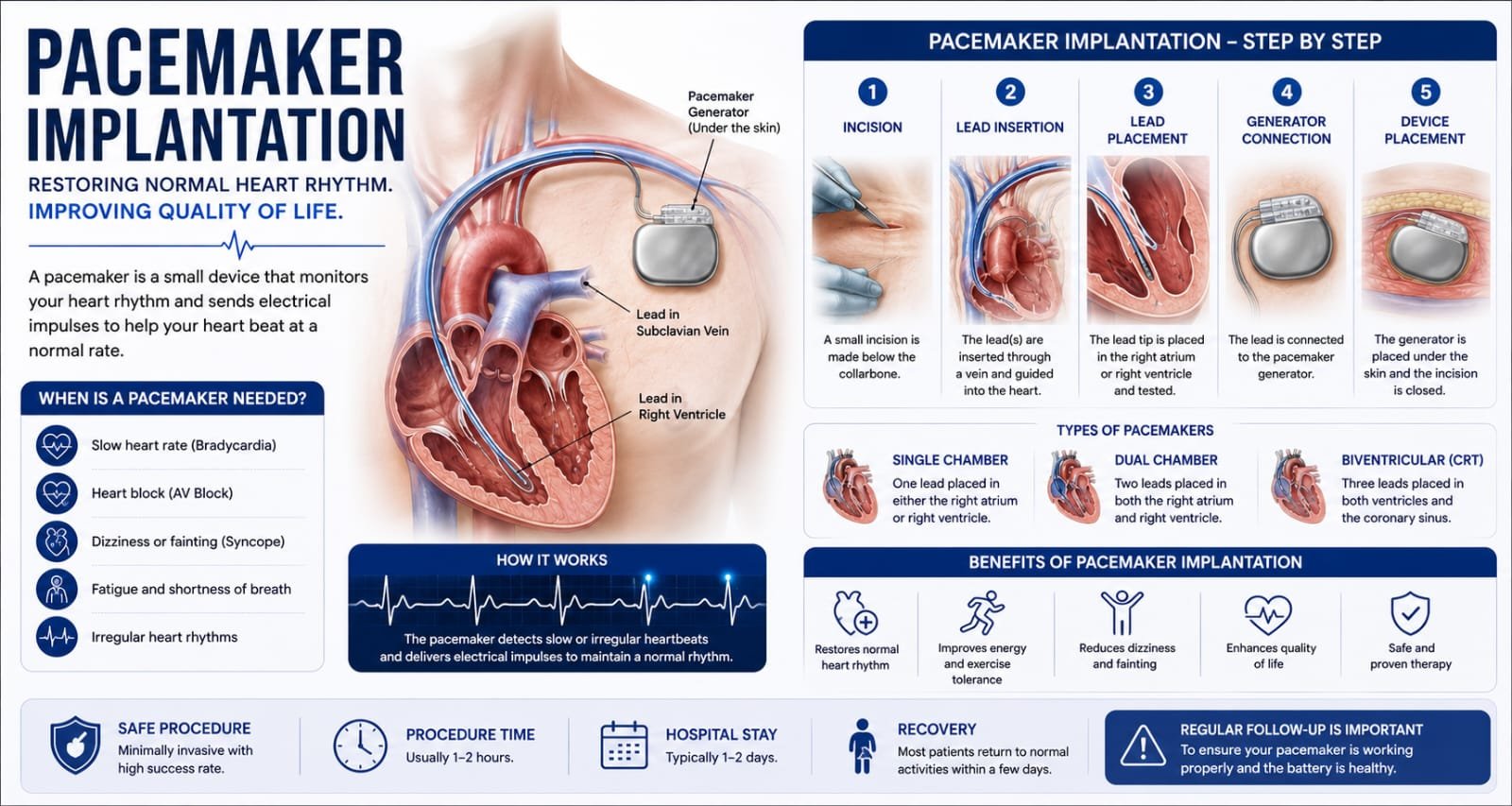
A pacemaker is a small device, implanted just under the skin near the collarbone, that monitors the heart’s rhythm and sends tiny electrical signals to keep it beating at a normal rate whenever it’s too slow. It doesn’t take over the heart’s job entirely — it steps in only when the heart’s own electrical system isn’t doing it reliably.
It’s generally recommended for conditions where the heart beats too slowly or irregularly, most commonly
:Bradycardia — an abnormally slow heart rate that causes symptoms like fatigue, dizziness, or fainting.
Heart block — a delay or interruption in the electrical signal that coordinates the heart’s contractions, which can range from mild to severe.
Sick sinus syndrome — a problem with the heart’s natural pacemaker (the sinus node), causing an irregular or unpredictable rhythm.
Certain cases after a heart attack — if the heart’s electrical pathways have been damaged.
Heart failure with specific rhythm problems — in select patients, a specialized type of pacemaker (CRT, discussed below) can help the heart’s chambers beat in better coordination.
Not everyone with a slow heart rate needs a pacemaker — athletes, for instance, often have naturally slower heart rates without any problem. The decision is based on symptoms, ECG findings, and specialized rhythm monitoring, not the heart rate number alone.
Symptoms That May Indicate You Need a Pacemaker
Fainting or near-fainting episodes (syncope), especially without clear warning.
Persistent dizziness or lightheadedness.
Unusual fatigue or breathlessness, particularly if it’s new or has gotten worse.
A noticeably slow or irregular pulse.
Confusion or difficulty concentrating, in some cases, due to reduced blood flow to the brain.
These symptoms have many possible causes, so they’re worth having evaluated rather than assumed — an ECG and rhythm monitoring are usually the first steps toward figuring out whether a pacemaker is actually needed.
Types of Pacemakers
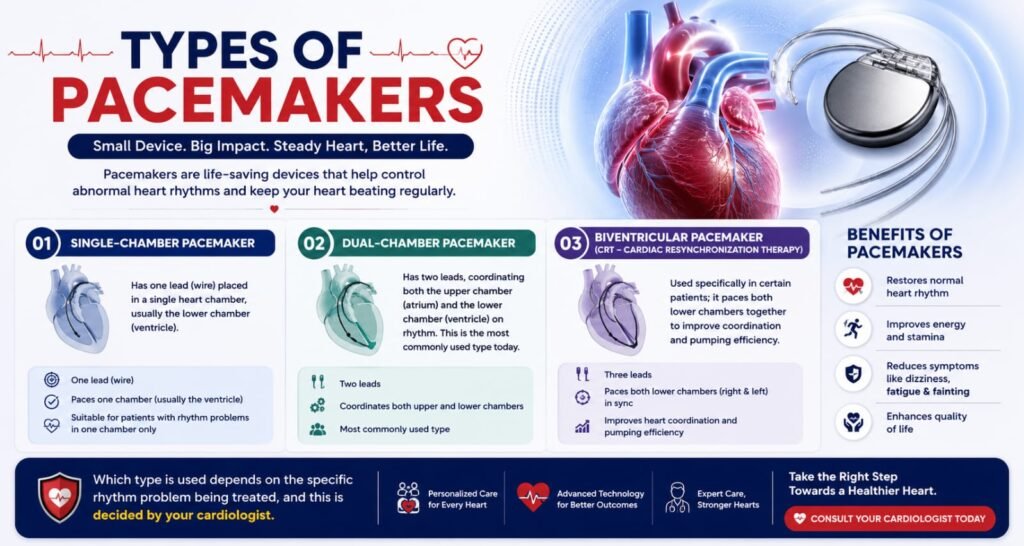
Single-chamber pacemaker — has one lead (wire) placed in a single heart chamber, usually the right ventricle. Used when only one chamber needs pacing support.
Dual-chamber pacemaker — has two leads, coordinating both the upper and lower chambers on the right side of the heart, which often allows for a more natural heart rhythm. This is the most commonly used type today.
Biventricular pacemaker (CRT – Cardiac Resynchronization Therapy) — used specifically in certain heart failure patients where the heart’s chambers aren’t contracting in sync; it paces both lower chambers together to improve coordination and pumping efficiency.
Which type is used depends on the specific rhythm problem being treated, and this is decided based on your ECG, rhythm monitoring, and overall heart function.
How the Procedure Works
Local anaesthesia: The procedure is usually done under local anaesthesia with sedation, so you’re relaxed but not fully asleep.
Small incision: A small incision, typically just below the collarbone, is made to create a pocket under the skin for the pacemaker device.
Lead placement: One or more thin, insulated wires (leads) are guided through a vein into the appropriate heart chamber(s), under X-ray guidance.
Connecting and testing: The leads are connected to the pacemaker device, and its function is tested before the incision is closed.
Closing up: The device is placed in the pocket under the skin, and the incision is closed with sutures.
The procedure typically takes about 1 to 2 hours.
Recovery After Pacemaker Implantation
Hospital stay: Usually 1–2 days, mainly for monitoring the device and rhythm afterward.
Arm movement: You’ll be advised to limit movement of the arm on the side of the implant for a short period (often around 4–6 weeks) to allow the leads to settle securely in place — your cardiologist will give you specific guidance.
Wound care: Keeping the incision site clean and dry, and watching for any signs of infection or unusual swelling.
Return to routine activity: Most people can resume normal daily activities within a few days to a couple of weeks, with strenuous activity and heavy lifting on the implanted side restricted for longer, per your doctor’s advice.
Follow-up and device checks: Regular check-ups are needed to confirm the device is working correctly and to monitor battery status, typically through in-clinic device interrogation.
Living With a Pacemaker
A pacemaker is designed to let you get back to a normal, active life — most patients can work, exercise, and travel as they did before, once fully recovered. A few practical precautions are worth knowing:
Mobile phones and headphones are generally safe with modern pacemakers, though it’s often advised to avoid holding a phone directly over the device for extended periods.
Airport security scanners are usually fine, but carrying your pacemaker ID card and informing security staff is recommended.
MRI scans require caution — many modern pacemakers are MRI-conditional (safe under specific settings), but this must always be confirmed with your cardiologist and the MRI center beforehand.
Household appliances (microwaves, induction cooktops at a normal distance, etc.) are generally safe for everyday use.
Strong magnetic fields and certain industrial equipment should be avoided or discussed with your doctor if relevant to your work.
Pacemaker Battery Life and Replacement
Pacemaker batteries typically last 8 to 12 years, depending on the device type, how frequently it’s actively pacing, and the settings used. When the battery runs low, this is picked up during routine device check-ups well before it becomes urgent, and a generator replacement procedure is performed — this is generally simpler than the original implantation, since the existing leads usually don’t need to be replaced, only the device itself.
Pacemaker Cost in Dehradun
Pacemaker cost depends primarily on the type of device (single-chamber, dual-chamber, or CRT), the device brand and model, and the hospital’s room category. As a general range across India, pacemaker implantation typically costs between ₹2.5 lakh and ₹4.5 lakh, with device type being the main factor. For an accurate estimate for your specific case, this is best discussed directly during consultation, once the type of pacemaker needed is clear. Pacemaker implantation is covered under most standard health insurance policies — bring your policy details to your first visit so this can be checked in advance.
Frequently Asked Questions
What is a pacemaker and who needs one?
A pacemaker is a small implanted device that sends electrical signals to keep the heart beating at a normal rate when it’s too slow. It’s needed by patients with conditions like bradycardia, heart block, or sick sinus syndrome, based on symptoms and rhythm testing.
What symptoms indicate you may need a pacemaker?
Fainting or near-fainting, persistent dizziness, unusual fatigue, breathlessness, or a noticeably slow pulse are common indicators, though these need proper evaluation to confirm the cause.
How is a pacemaker implanted, and how long does the procedure take?
It’s done under local anaesthesia with sedation, through a small incision below the collarbone, with leads guided into the heart via a vein. The procedure typically takes about 1–2 hours.
What is the difference between a permanent and temporary pacemaker?
A permanent pacemaker is implanted for long-term use. A temporary pacemaker is used for short-term, urgent situations — such as immediately after a heart attack or during certain emergencies — until the heart’s rhythm stabilizes or a permanent device is implanted if needed.
What is the difference between single-chamber, dual-chamber, and biventricular pacemakers?
Single-chamber devices pace one heart chamber, dual-chamber devices coordinate two chambers for a more natural rhythm, and biventricular (CRT) devices are used specifically in certain heart failure patients to help both lower chambers beat in sync.
How much does a pacemaker cost in Dehradun?
Generally between ₹2.5 lakh and ₹4.5 lakh depending on the device type and hospital, though this is best confirmed for your specific case during consultation.
How long does a pacemaker battery last, and what happens when it runs out?
Typically 8 to 12 years. When the battery runs low, this is caught during routine check-ups, and a generator replacement procedure is done — usually simpler than the original implant since the leads are typically kept in place.
What is the recovery time after pacemaker implantation?
Hospital stay is usually 1–2 days, with arm movement on the implanted side restricted for a few weeks to let the leads settle. Most people return to normal daily activity within days to a couple of weeks.
What precautions must I take with a pacemaker?
Everyday items like mobile phones and most household appliances are generally safe. MRI scans need prior confirmation with your cardiologist, and it’s advisable to carry your pacemaker ID card, particularly at airport security.
Can I live a normal life, travel, and exercise with a pacemaker?
Yes, most patients return to their normal routine, including work, travel, and exercise, once fully recovered, with specific guidance from your cardiologist on any activity restrictions relevant to your case.
What are the risks or complications of pacemaker implantation?
As with any implanted device procedure, possible risks include infection at the incision site, bleeding, or lead displacement. Serious complications are uncommon with experienced implantation and proper follow-up care.
How often do I need pacemaker check-ups?
Regular follow-up visits are needed to check the device’s function and battery status, typically through in-clinic device interrogation, with the exact schedule set by your cardiologist based on your device and condition.
Closing Section (soft CTA — NMC-compliant, no promotional claims)
If you’ve been experiencing fainting spells, dizziness, or unusual fatigue, or a pacemaker has already been recommended for you, it helps to discuss your specific rhythm findings with a cardiologist directly. Dr. Richa Sharma consults with patients in Dehradun on pacemaker evaluation, implantation, and long-term follow-up care.