

Heart Valve Treatment in Dehradun
A lot of people first learn they have a valve problem because a doctor heard something unusual while listening to their heart — a murmur — during a routine check-up, long before any symptoms showed up. That moment can feel alarming, but heart valve disease covers a wide range of severity, and many cases are simply monitored for years without needing any procedure at all. This page explains how the heart’s valves work, what goes wrong when they don’t, and what the real treatment path looks like.
Dr. Richa Sharma is an Interventional Cardiologist practicing in Dehradun, evaluating and managing patients with valve disease, from routine monitoring through to guiding patients toward surgical or catheter-based treatment when it’s needed.
What Is Heart Valve Disease?
The heart has four valves — the mitral, aortic, tricuspid, and pulmonary valves — that act like one-way doors, opening and closing with each heartbeat to keep blood flowing in the right direction through the heart’s four chambers. Valve disease happens when one or more of these valves doesn’t work properly, in one of two broad ways:
Stenosis — the valve becomes narrowed or stiff, restricting how much blood can pass through it.
Regurgitation (or “leaking”) — the valve doesn’t close fully, allowing blood to flow backward instead of moving forward efficiently.
The mitral and aortic valves, on the left side of the heart, are affected most often, since the left side of the heart works under higher pressure. Valve problems can range from mild, requiring nothing more than periodic monitoring, to severe, where the heart is working significantly harder than it should and treatment becomes necessary to prevent complications like heart failure.
What Causes Heart Valve Disease?
Age-related wear and calcium buildup — over time, valve tissue can stiffen and calcify, particularly the aortic valve; this is one of the most common causes of valve disease in older adults.
Rheumatic heart disease — caused by an untreated childhood streptococcal throat infection that leads to long-term valve damage, particularly of the mitral valve; this remains a notably more common cause in India compared to many Western countries.
Congenital valve abnormalities — some people are born with a valve that has an unusual structure, such as a bicuspid aortic valve (two flaps instead of three), which tends to wear out earlier than a normal valve.
Infective endocarditis — an infection of the valve tissue, sometimes following dental procedures or other infections in people at higher risk.
Prior heart attack — can damage the muscle and structures that support the mitral valve, leading to leakage.
Connective tissue disorders — certain inherited conditions can affect valve tissue strength and structure.
In India specifically, it’s worth noting that rheumatic valve disease is still seen meaningfully more often than in many other countries, particularly in patients who didn’t have access to prompt treatment for strep throat infections in childhood — this is part of why a careful medical history matters in evaluating valve disease here.
Symptoms of Heart Valve Disease
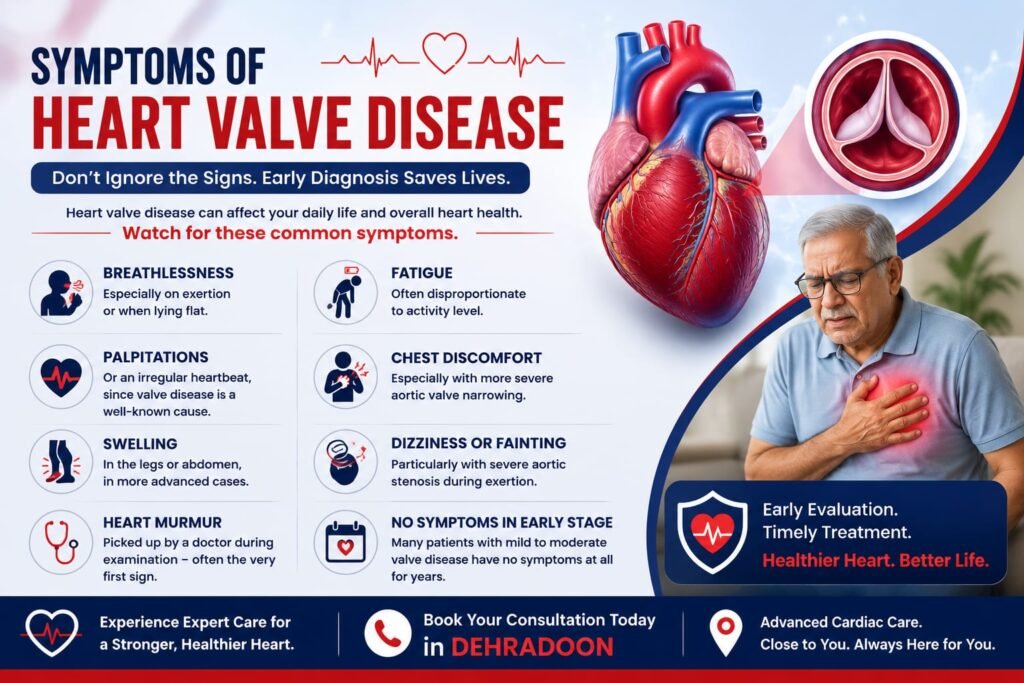
Breathlessness, especially on exertion or when lying flat.
Fatigue, often disproportionate to activity level.
Palpitations or an irregular heartbeat, since valve disease is a well-known cause of certain valve-related rhythm issues, particularly atrial fibrillation.
Chest discomfort, especially with more severe aortic valve narrowing.
Swelling in the legs or abdomen, in more advanced cases.
Dizziness or fainting, particularly with severe aortic stenosis during exertion.
A heart murmur picked up by a doctor during examination — often the very first sign, before any symptoms appear at all.
Many patients with mild to moderate valve disease have no symptoms at all for years, which is why a murmur found incidentally, or a routine check-up, often leads to the diagnosis before the person has noticed anything themselves.
How Is Heart Valve Disease Diagnosed?
Clinical examination — listening for a heart murmur is usually the first clue that prompts further testing.
Echocardiogram — the primary test for valve disease; it shows exactly which valve is affected, how severely, and how well the heart is coping with the extra workload.
ECG — checks for related rhythm problems or signs of strain on the heart.
Chest X-ray — can show heart enlargement or fluid in the lungs in more advanced cases.
Transesophageal echocardiogram (TEE), in select cases — a more detailed version of the echo, done from inside the food pipe, used when a clearer view of a specific valve is needed.
Cardiac catheterization or CT, in some cases — to assess related coronary artery disease before valve surgery, or to plan certain catheter-based valve procedures.
Treatment Options for Heart Valve Disease
Treatment depends entirely on which valve is affected, whether it’s narrowed or leaking, how severe the problem is, and whether it’s actually causing symptoms or straining the heart.
Monitoring
Many patients with mild valve disease need nothing more than regular check-ups and periodic echocardiograms to track whether the condition is stable or progressing. This is a legitimate, commonly used approach, not a delay in care.
Medication
While medication can’t repair or replace a damaged valve, it plays an important role in managing symptoms, controlling blood pressure, treating any related heart failure or arrhythmia, and in some cases, preventing complications like blood clots.
Valve repair or replacement surgery
For moderate to severe valve disease causing symptoms or significant strain on the heart, surgical repair (fixing the patient’s own valve) or replacement (with a mechanical or biological artificial valve) is often recommended. Repair is generally preferred where feasible, particularly for the mitral valve, since it preserves the patient’s own tissue.
Catheter-based valve procedures
For select patients, particularly those at higher surgical risk, certain valve problems — most notably severe aortic stenosis — can now be treated through a catheter-based approach rather than open-heart surgery, inserting a replacement valve through a blood vessel. Whether this option is appropriate depends on the specific valve involved, the patient’s overall health, and detailed imaging assessment.
The decision between monitoring, medication, and a procedure is made based on the type and severity of valve disease, symptoms, and how the heart’s overall function is holding up — this is typically reassessed at each follow-up rather than decided once and left unchanged.
Living With Valve Disease Before Treatment Is Needed
A valve disease diagnosis doesn’t necessarily mean an immediate procedure is coming. For many patients, it means a structured plan of regular monitoring, usually with annual or twice-yearly echocardiograms depending on severity, along with attention to any new or worsening symptoms in between visits. Knowing what symptoms to watch for, and reporting them promptly rather than waiting for the next scheduled check-up, is one of the most useful things a patient can do to make sure treatment happens at the right time, not too early and not too late.
Frequently Asked Questions
What is heart valve disease?
It’s a condition where one or more of the heart’s four valves doesn’t work properly, either becoming narrowed (stenosis) or leaking (regurgitation), affecting how efficiently blood flows through the heart.
What causes heart valve disease?
Common causes include age-related wear and calcium buildup, rheumatic heart disease from an untreated childhood throat infection, congenital valve abnormalities, infection of the valve, and, in some cases, damage following a heart attack.
What are the symptoms of a heart valve problem?
Breathlessness, fatigue, palpitations, chest discomfort, and swelling in the legs are common symptoms, though many people with mild to moderate valve disease have no symptoms at all for years.
How is heart valve disease diagnosed?
Usually starting with a doctor hearing a heart murmur during examination, followed by an echocardiogram, which is the main test used to assess which valve is affected and how severely.
Does every valve problem need surgery?
No — many cases, especially mild ones, are managed with regular monitoring alone for years. Surgery or a procedure is considered when the valve disease becomes moderate to severe and is causing symptoms or significant strain on the heart.
What is the difference between valve repair and valve replacement?
Repair fixes the patient’s own valve and is generally preferred when feasible, particularly for the mitral valve, since it preserves the natural tissue. Replacement involves substituting the valve with a mechanical or biological artificial one, used when repair isn’t a suitable option.
What is a catheter-based valve procedure?
It’s a less invasive alternative to open-heart valve surgery, where a replacement valve is inserted through a blood vessel using a catheter, rather than opening the chest. It’s suitable for select patients and specific valve conditions, most notably certain cases of severe aortic stenosis.
Can heart valve disease cause an irregular heartbeat?
Yes — valve disease, particularly involving the mitral valve, is a recognized cause of certain arrhythmias, most commonly atrial fibrillation, due to the extra strain and enlargement it can cause in the heart’s upper chambers.
Is heart valve disease common in India?
Both age-related valve disease and rheumatic valve disease are seen in India, with rheumatic valve disease notably more common here than in many Western countries, largely linked to childhood strep throat infections that weren’t treated promptly.
What is a heart murmur, and does it always mean a valve problem?
A murmur is an unusual sound heard while listening to the heart, caused by turbulent blood flow. It often indicates a valve problem, but not always — some murmurs are harmless (“innocent murmurs”) and need no treatment, which is why further evaluation with an echocardiogram is important to tell the difference.
How often should valve disease be monitored?
This varies based on which valve is affected and how severe the problem is — mild cases may be checked every one to two years, while more significant valve disease is monitored more closely, often with echocardiograms every six to twelve months.
When should I see a cardiologist about a possible valve problem?
If a murmur has been detected, or if you’re experiencing breathlessness, unexplained fatigue, palpitations, or dizziness, it’s worth getting a proper evaluation, including an echocardiogram, rather than assuming it’s nothing.
Closing Section (soft CTA — NMC-compliant, no promotional claims)
Whether a murmur was recently picked up during a check-up or you already know you have valve disease and want to understand your options, it helps to go through the specifics of your case with a cardiologist directly. Dr. Richa Sharma consults with patients in Dehradun on valve disease evaluation, monitoring, and treatment planning.
