Heart Failure Treatment in Dehradun
Hearing the term “heart failure” for the first time is unsettling, mostly because the name sounds far worse than what it usually means. It doesn’t mean the heart has stopped working — it means the heart isn’t pumping blood as efficiently as it should, and with the right treatment, most patients live full, active lives for many years after diagnosis. This page explains what heart failure actually is, what causes it, how it’s staged, and what treatment realistically involves.Dr. Richa Sharma is an Interventional Cardiologist practicing in Dehradun, managing heart failure patients from initial diagnosis through long-term treatment and, where needed, device-based therapy.
What Is Heart Failure?
Heart failure is a condition in which the heart muscle becomes weakened or stiff and can’t pump blood around the body as well as it should. It can affect the left side of the heart, the right side, or both, and it can develop suddenly (acute heart failure) or gradually over months and years (chronic heart failure).
There are two broad types, based on how the heart’s pumping function is affected:
Heart failure with reduced ejection fraction (HFrEF) — the heart muscle has weakened and isn’t squeezing strongly enough with each beat.
Heart failure with preserved ejection fraction (HFpEF) — the heart squeezes normally but the muscle has become stiff, so it doesn’t fill with blood properly between beats.
Both types cause blood to back up in the body, which is why fluid retention — swelling in the legs, breathlessness, and fatigue — is central to how heart failure presents, regardless of type.
What Causes Heart Failure?
Heart failure is usually the end result of another condition that has damaged or overworked the heart over time, rather than a disease that starts on its own. Common causes include:Coronary artery disease and past heart attacks — damaged heart muscle from a previous blockage or heart attack is one of the most common causes.Long-standing high blood pressure — forces the heart to work harder over years, eventually weakening it.
Heart valve disease — leaking or narrowed valves make the heart work inefficiently.
Cardiomyopathy — diseases of the heart muscle itself, which can be genetic, viral, alcohol-related, or without a clearly identified cause.
Arrhythmias — some persistent rhythm problems can weaken the heart muscle over time if left untreated.
Diabetes and obesity — both increase strain on the cardiovascular system and are strongly linked to heart failure risk.
Certain infections or toxins, including some chemotherapy drugs and, in specific cases, viral infections affecting the heart muscle.
Often, more than one of these factors is present together, and identifying the underlying cause is one of the first and most important steps in treatment, since it shapes the whole approach.
Symptoms of Heart Failure
Breathlessness, particularly on exertion, while lying flat, or that wakes you up at night.
Swelling in the legs, ankles, or abdomen, caused by fluid retention.
Persistent fatigue and weakness, even with normal daily activity.
Rapid or irregular heartbeat.
Sudden weight gain over a few days, due to fluid buildup.
Reduced appetite or nausea, especially in more advanced cases.
A persistent cough or wheeze, sometimes with white or pink-tinged mucus.
These symptoms can develop gradually, which is why many patients adjust their routines around them for months before seeking help — noticing that you’ve unconsciously started avoiding stairs or errands is often a sign worth paying attention to.
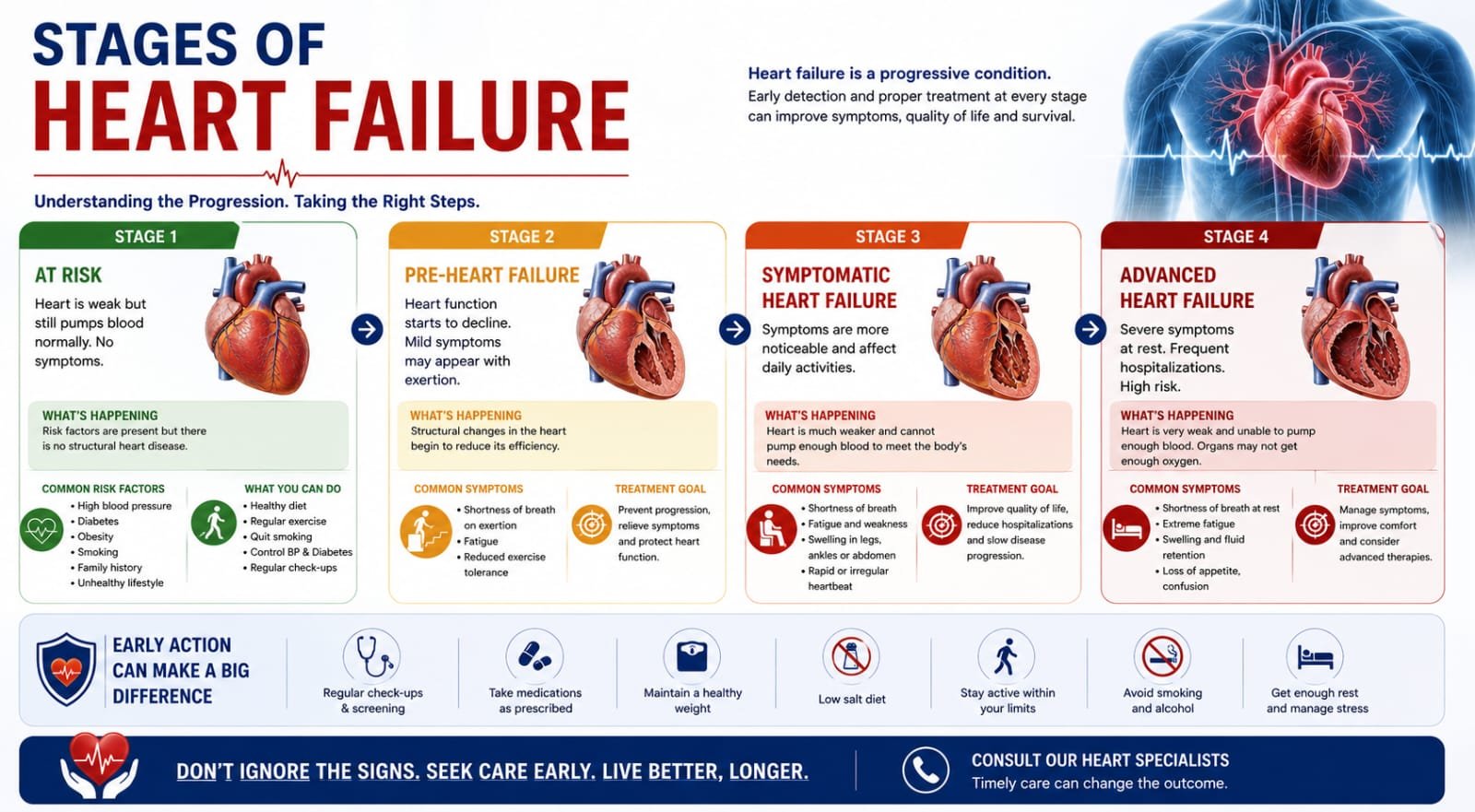
Stages of Heart Failure
Heart failure is commonly classified using the New York Heart Association (NYHA) functional classification, which describes how much symptoms limit daily activity:
Class I — heart disease is present, but no symptoms and no limitation of physical activity.
Class II — mild symptoms with ordinary activity, comfortable at rest.
Class III — noticeable limitation of activity; comfortable only at rest.
Class IV — symptoms present even at rest; unable to carry out physical activity without discomfort.
A separate staging system (American College of Cardiology/American Heart Association, Stages A–D) looks at disease progression from risk factors alone (Stage A) through to advanced, treatment-resistant heart failure (Stage D). Your cardiologist will place your specific case within these frameworks to guide treatment decisions and track progress over time.
How Is Heart Failure Diagnosed?
Clinical examination — checking for fluid retention, abnormal heart sounds, and signs of reduced circulation.
Echocardiogram — the key test that measures the heart’s pumping function (ejection fraction) and looks at valve function and chamber size.
ECG — checks for rhythm problems and signs of past heart attacks.
Blood tests, including a marker called BNP or NT-proBNP, which rises when the heart is under strain, along with kidney and thyroid function tests since both can affect or mimic heart failure symptoms.
Chest X-ray — can show fluid in the lungs or an enlarged heart.
Coronary angiography, if coronary artery disease is suspected as the underlying cause.
Treatment for Heart Failure
Heart failure treatment has improved substantially over the past decade, and most patients today are managed well with a combination of the following:
Medication
Several classes of medication work together to reduce the heart’s workload, control fluid retention, and, importantly, help the heart muscle recover function over time. These typically include ACE inhibitors or ARNI drugs, beta-blockers, mineralocorticoid receptor antagonists, and diuretics for fluid control, along with newer classes such as SGLT2 inhibitors, which have shown meaningful benefit in heart failure regardless of diabetes status. The specific combination and dosing is tailored to each patient and adjusted over time.
Lifestyle and self-monitoring
Salt and fluid restriction as advised, daily weight monitoring to catch fluid buildup early, staying active within safe limits, and strict management of any underlying conditions like diabetes or high blood pressure.
Device-based therapy
In select patients, particularly those with certain rhythm problems alongside heart failure, a specialized pacemaker (CRT) or an implantable defibrillator (ICD) may be recommended to improve heart coordination or protect against dangerous rhythm problems.
Treating the underlying cause
If heart failure is due to a treatable cause — such as a blocked artery, a leaking valve, or an uncontrolled arrhythmia — addressing that condition directly, through angioplasty, valve treatment, or rhythm management, is often part of the overall plan.Treatment is not usually a single decision made once — it’s an ongoing relationship with regular follow-up, medication adjustments, and monitoring, since heart failure is a condition that’s managed over the long term rather than “cured” in most cases.
Frequently Asked Questions
What is heart failure and is it the same as a heart attack?
No — a heart attack is a sudden blockage that damages heart muscle, while heart failure is an ongoing condition where the heart doesn’t pump as efficiently as it should. A heart attack can be one of several causes of heart failure, but they aren’t the same thing.
What are the main symptoms of heart failure?
Breathlessness (especially on exertion or lying flat), swelling in the legs or abdomen, persistent fatigue, and sudden weight gain from fluid retention are the most common symptoms.
What causes heart failure?
Common causes include coronary artery disease and past heart attacks, long-standing high blood pressure, valve disease, cardiomyopathy, and certain arrhythmias, often in combination.
Can heart failure be cured?
In most cases, heart failure is a long-term condition that’s managed rather than cured, though treatment can significantly improve symptoms, heart function, and quality of life. Some cases with a clearly reversible cause can improve substantially once that cause is treated.
What are the stages of heart failure?
Heart failure is commonly classified by how much symptoms limit activity, from Class I (no limitation) to Class IV (symptoms even at rest), alongside a separate staging system that tracks disease progression from risk factors to advanced disease.
How is heart failure diagnosed?
Mainly through an echocardiogram, which measures the heart’s pumping function, along with an ECG, blood tests (including BNP), and a chest X-ray. Further tests like angiography may be done if an underlying cause needs to be identified.
What is ejection fraction, and why does it matter?
Ejection fraction is the percentage of blood the heart pumps out with each beat, measured on an echocardiogram. It’s one of the key numbers used to classify heart failure type and guide treatment decisions.
What medications are used for heart failure?
A combination of medications is typically used, including drugs that reduce the heart’s workload, control fluid retention, and support heart muscle recovery, adjusted individually based on the patient’s specific condition and response.
Is a pacemaker or defibrillator needed for heart failure?
Not for every patient — device therapy (CRT or ICD) is considered in select cases, particularly where there are also certain rhythm problems or a significantly reduced ejection fraction, based on specific clinical criteria.
What diet and lifestyle changes help with heart failure?
Salt and fluid restriction as advised, daily weight monitoring to catch early fluid buildup, staying appropriately active, and strict control of related conditions like diabetes and high blood pressure are central to management.
Can someone with heart failure live a normal, active life?
Yes, for most patients, with consistent treatment and monitoring. Many people return to work, travel, and regular activity, with adjustments based on their specific condition and its severity.
When should I see a cardiologist if I suspect heart failure?
Persistent breathlessness, new swelling in the legs or abdomen, unexplained fatigue, or sudden unexplained weight gain over a few days are all reasons to get evaluated promptly rather than waiting.
Closing Section (soft CTA — NMC-compliant, no promotional claims)
Whether you’re experiencing symptoms that concern you or have already received a heart failure diagnosis and want a clearer treatment plan, it helps to go through your specific situation with a cardiologist directly. Dr. Richa Sharma consults with patients in Dehradun on heart failure diagnosis, medication management, and device-based therapy when needed.