
Heart Checkup in Dehradun
Most of the pages on this site talk about what happens after something has already gone wrong with the heart. This one is about catching problems earlier, or better yet, before they start at all. A heart checkup isn’t just for people with symptoms — it’s for anyone who wants an honest, current picture of where their heart health actually stands, especially given how often heart disease develops quietly for years before it announces itself.
Dr. Richa Sharma is an Interventional Cardiologist practicing in Dehradun, offering structured heart health checkups for both symptom-free individuals with risk factors and patients wanting a general cardiac evaluation.
Why a Heart Checkup Matters, Even Without Symptoms
Heart disease has a well-earned reputation for being silent in its early stages. Plaque builds up in the arteries gradually over years without causing any noticeable symptoms until a blockage becomes significant, or until a heart attack happens without warning. High blood pressure, high cholesterol, and early diabetes are the same way — they rarely announce themselves through how a person feels.
This is exactly why a checkup based on how you feel isn’t enough on its own. A structured heart checkup looks at the numbers and the heart’s actual structure and function, independent of symptoms, which is the only reliable way to catch risk factors and early disease before they progress.
Who Should Get a Heart Checkup?
Anyone above 30–35, as a general starting point for baseline risk assessment, even without any complaints.
People with a family history of heart disease, particularly if a parent or sibling had a heart attack, bypass surgery, or stent at a relatively young age.
People with diabetes, high blood pressure, or high cholesterol, since these conditions directly affect heart health and benefit from regular cardiac monitoring, not just management of the condition itself.
Smokers or those with a significant smoking history, given the well-established impact of smoking on the arteries.
People who are overweight or largely sedentary, as both are independent risk factors for heart disease.
Anyone with new or occasional symptoms that haven’t yet been fully investigated, such as mild breathlessness on exertion or occasional palpitations.
Women approaching or past menopause, since the natural protective effect of estrogen on the heart declines at this stage, and heart disease risk rises accordingly.
Anyone returning to intense physical activity after a long gap, such as starting a new exercise programme or preparing for an athletic event later in life.
What's Included in a Heart Checkup
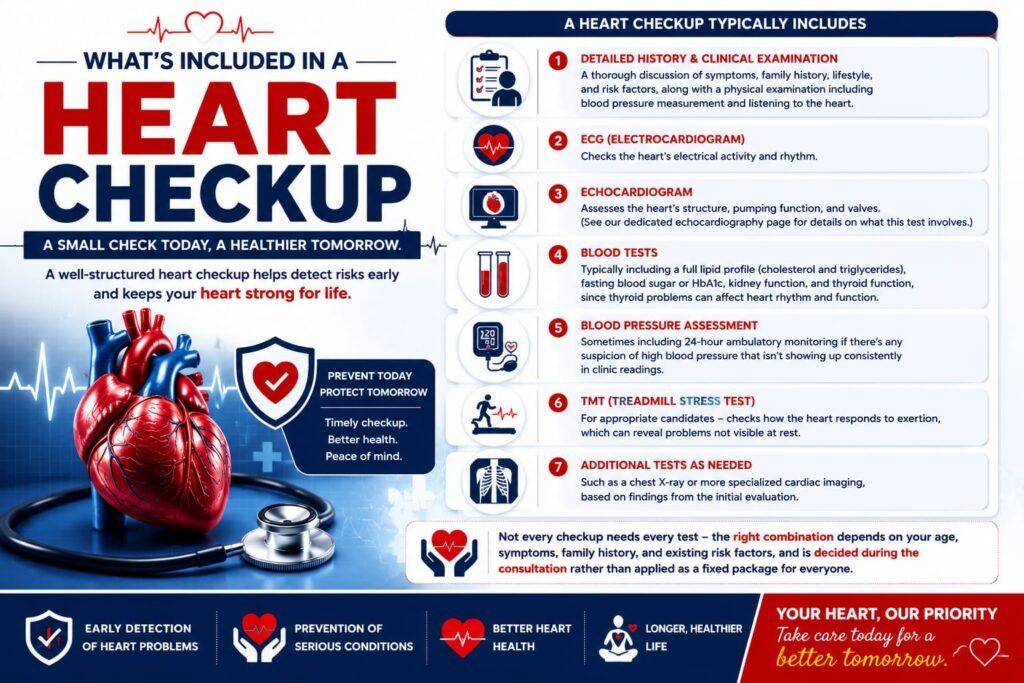
A well-structured heart checkup typically includes a combination of the following, adjusted based on age, risk factors, and any symptoms:
Detailed history and clinical examination — a thorough discussion of symptoms, family history, lifestyle, and risk factors, along with a physical examination including blood pressure measurement and listening to the heart.
ECG (electrocardiogram) — checks the heart’s electrical activity and rhythm.
Echocardiogram — assesses the heart’s structure, pumping function, and valves. (See our dedicated echocardiography page for details on what this test involves.)
Blood tests — typically including a full lipid profile (cholesterol and triglycerides), fasting blood sugar or HbA1c, kidney function, and thyroid function, since thyroid problems can affect heart rhythm and function.
Blood pressure assessment, sometimes including 24-hour ambulatory monitoring if there’s any suspicion of high blood pressure that isn’t showing up consistently in clinic readings.
TMT (treadmill stress test), for appropriate candidates — checks how the heart responds to exertion, which can reveal problems not visible at rest.
Additional tests as needed, such as a chest X-ray or more specialized cardiac imaging, based on findings from the initial evaluation.
Not every checkup needs every test — the right combination depends on your age, symptoms, family history, and existing risk factors, and this is decided during the consultation rather than applied as a fixed package for everyone.
How Often Should You Get a Heart Checkup?
Low risk, no symptoms, under 40: Generally every 2–3 years is reasonable, alongside routine blood pressure and cholesterol checks as advised by a physician.
Moderate risk factors present (family history, borderline cholesterol, overweight): Typically annually.
Diabetes, high blood pressure, or known heart disease: Usually annually or more frequently, based on your cardiologist’s specific advice for your condition.
After any cardiac event or procedure: Follow-up frequency is set individually based on your treatment and recovery.
These are general guidelines rather than fixed rules — your cardiologist will recommend a personalised schedule based on your actual risk profile and any findings from your first checkup.
What Happens If the Checkup Finds Something?
Finding an issue during a checkup is, in a real sense, the checkup working as intended — catching a problem early, when there are usually more options and better outcomes than if it’s found later. Depending on what’s found, the next step could be as simple as starting or adjusting medication and lifestyle changes, or it could mean being further evaluated with angiography if there’s reason to suspect a significant coronary blockage, with angioplasty may be discussed as a treatment option if a blockage is confirmed and found to be significant. Whatever the finding, it will be explained clearly, along with a specific plan, rather than left as just a number on a report.
Preparing for Your Heart Checkup
Fasting is usually required for 8–10 hours if blood sugar and cholesterol tests are included — checkups are commonly scheduled in the morning for this reason.
Bring your medical history, including any previous test reports, current medications, and details of any past heart problems in your family.
Wear comfortable clothing, particularly if a treadmill test is planned.
Avoid heavy exercise or caffeine for a few hours before the appointment, if a stress test is part of your checkup.
Heart Checkup Cost in Dehradun
Cost varies depending on which tests are included — a basic checkup with consultation, ECG, and blood pressure assessment costs less than a comprehensive package that includes an echocardiogram, detailed blood work, and a treadmill test. As a general guide, a comprehensive heart checkup in Dehradun typically ranges from around ₹2,500 to ₹8,000, depending on which tests are included. The exact package and cost will be discussed and confirmed before your appointment, based on what’s appropriate for your age and risk profile.
Frequently Asked Questions
Do I need a heart checkup if I have no symptoms?
Yes, particularly if you have risk factors like family history, diabetes, high blood pressure, high cholesterol, or a sedentary lifestyle. Heart disease is often silent in its early stages, so waiting for symptoms means missing the window where problems are easiest to manage.
At what age should I start getting regular heart checkups?
Around 30–35 is a reasonable general starting point, earlier if there’s a strong family history of heart disease or other significant risk factors present.
What tests are included in a typical heart checkup?
A standard checkup usually includes a clinical examination, ECG, blood pressure assessment, and blood tests for cholesterol and blood sugar. A more comprehensive checkup may add an echocardiogram and a treadmill stress test, depending on your risk profile.
How much does a full heart checkup cost in Dehradun?
This depends on which tests are included, typically ranging from around ₹2,500 for a basic checkup to ₹8,000 for a comprehensive package including an echo and stress test.
How often should I get a heart checkup done?
This depends on your risk profile — roughly every 2–3 years for low-risk individuals under 40, and annually or more often for those with risk factors like diabetes, high blood pressure, or a family history of heart disease.
Is fasting required before a heart checkup?
Yes, if blood sugar and cholesterol tests are part of the checkup, fasting for 8–10 hours beforehand is usually required, which is why checkups are commonly scheduled in the morning.
Can a heart checkup detect a blocked artery?
A standard checkup with ECG and echo can pick up signs suggestive of a problem, but confirming a blocked artery definitively usually requires further evaluation, such as a treadmill test followed by angiography if warranted by the findings.
Is a heart checkup necessary if my blood tests from a general physical are normal?
A general physical often doesn’t include a detailed cardiac evaluation like an ECG, echocardiogram, or stress test, so normal general blood work doesn’t rule out early heart disease on its own, particularly if risk factors are present.
Should women get heart checkups, or is heart disease mainly a concern for men?
Heart disease affects women significantly too, and risk rises notably after menopause. Women are sometimes underdiagnosed because symptoms can be less typical, which makes proactive checkups particularly worthwhile.
What happens if my heart checkup finds an abnormality?
It will be explained clearly, along with the appropriate next step, which could range from lifestyle changes and medication to further testing, depending on what’s found and how significant it is.
Can a heart checkup replace seeing a doctor if I already have chest pain?
No — a routine checkup is for proactive screening. If you’re already having symptoms like chest pain, breathlessness, or palpitations, that warrants a direct consultation and targeted evaluation rather than waiting for a routine checkup.
Is a treadmill test (TMT) always part of a heart checkup?
Not always — it’s included for appropriate candidates based on age, symptoms, and risk factors, and your cardiologist will advise whether it’s needed as part of your specific checkup.
Closing Section (soft CTA — NMC-compliant, no promotional claims)
Whether you’re proactively checking on your heart health, managing known risk factors, or simply haven’t had a proper cardiac evaluation in years, Dr. Richa Sharma offers structured heart checkups for patients in Dehradun, tailored to individual age, symptoms, and risk profile.