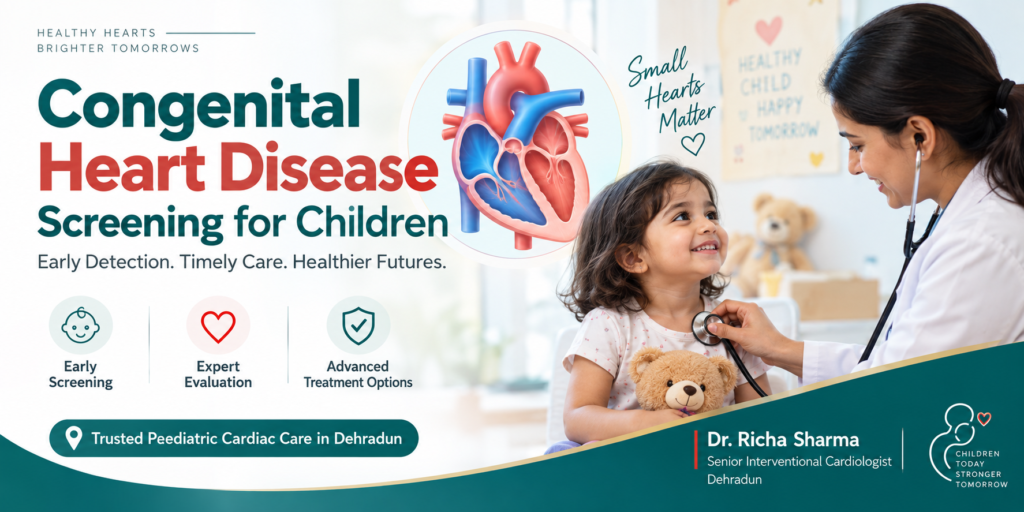
Congenital Heart Disease Screening for Children

Understanding Congenital Heart Conditions

Congenital heart disease refers to structural heart problems present from birth, ranging from conditions that need no treatment to others requiring intervention early in life. Common examples include atrial septal defects (ASD), ventricular septal defects (VSD), and patent ductus arteriosus (PDA).

Dr. Sharma's Experience in This Area

Alongside her adult interventional practice, Dr. Richa Sharma has experience with paediatric device closures for conditions like PDA, ASD, and VSD — procedures that can often correct certain structural defects without open surgery.

When Screening Is Recommended

A murmur detected during a routine paediatric check-up
A family history of congenital heart conditions
Symptoms such as poor weight gain, unusual tiredness, or breathlessness during feeding or play in infants and children

FAQs

Do all congenital heart defects require treatment?
No — some are minor and simply monitored over time, while others need intervention. This is assessed individually.

What does a device closure procedure involve?
Certain defects, like ASD or PDA, can sometimes be closed using a catheter-based device rather than open-heart surgery, depending on the specific case.

At what age can these conditions be diagnosed?
Some are detected at birth or in infancy; others are picked up later during a routine check-up or when symptoms appear.
Appointment
×

Appointment Form