Arrhythmia Treatment in Dehradun
A racing heartbeat, a sudden skip, or a fluttering feeling in the chest is one of the most common reasons people end up searching for a cardiologist late at night. Most of the time it isn’t dangerous, but sometimes it is, and the only way to know the difference is to get it properly checked. This page explains what arrhythmia actually means, the different types, what causes them, and what treatment usually involves.
Dr. Richa Sharma is an Interventional Cardiologist practicing in Dehradun, evaluating and treating patients with irregular heart rhythms, from occasional palpitations to more serious rhythm disorders.
What Is an Arrhythmia?
An arrhythmia is any abnormality in the heart’s normal rhythm — it can beat too fast (tachycardia), too slow (bradycardia), or irregularly, skipping or adding beats. The heart’s rhythm is controlled by an internal electrical system, starting with a natural pacemaker called the sinus node; when this system misfires anywhere along its path, the result is an arrhythmia.
Not every arrhythmia is dangerous. Many people experience occasional extra or skipped beats that are harmless and don’t need treatment. Others involve sustained abnormal rhythms that raise the risk of stroke, heart failure, or, in rare cases, sudden cardiac events — which is why any persistent or concerning symptom is worth evaluating rather than assuming it’s minor.
Common Types of Arrhythmia
Atrial fibrillation (AFib) — the most common serious arrhythmia, where the upper chambers of the heart beat chaotically and irregularly instead of in a coordinated rhythm. It significantly raises stroke risk if untreated.
Atrial flutter — similar to AFib but with a more organized, rapid rhythm in the upper chambers.
Supraventricular tachycardia (SVT) — episodes of a sudden, fast heartbeat originating above the heart’s lower chambers, often starting and stopping abruptly.
Ventricular tachycardia and ventricular fibrillation — more serious arrhythmias originating in the heart’s lower chambers, which can be life-threatening and need urgent treatment.
Bradyarrhythmias — abnormally slow heart rhythms, including sick sinus syndrome and heart block, sometimes requiring a pacemaker.
Premature beats (ectopics) — extra beats from either the upper or lower chambers, usually harmless when occasional, but worth evaluating if frequent or symptomatic.
What Causes Arrhythmias?
Coronary artery disease and past heart attacks — damaged heart tissue can disrupt the heart’s electrical pathways.
High blood pressure, which over time can change the heart’s structure and its electrical behavior.
Heart valve disease, since abnormal blood flow and chamber enlargement from valve problems are a well-recognized cause of certain valve-related rhythm issues, particularly atrial fibrillation.
Thyroid problems, especially an overactive thyroid, which is a common and often overlooked cause of a fast or irregular heartbeat.
Electrolyte imbalances — abnormal levels of potassium, magnesium, or calcium in the blood can trigger rhythm disturbances.
Excess caffeine, alcohol, or stimulant use, which can provoke palpitations or trigger arrhythmias in susceptible individuals.
Sleep apnea, increasingly recognized as a contributing factor to atrial fibrillation.
Age, since the risk of arrhythmias, particularly AFib, rises significantly after age 60.
Family history and certain inherited heart conditions, in a smaller number of cases, particularly in younger patients.
Symptoms of Arrhythmia
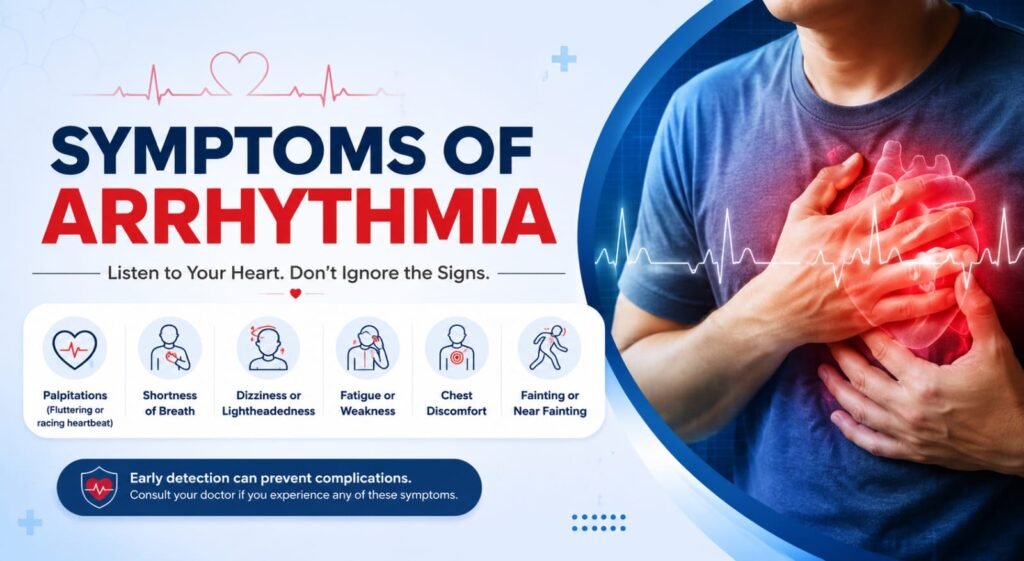
Palpitations — a fluttering, pounding, or racing sensation in the chest.
Skipped or extra beats, sometimes felt as a “flip” or “jump” in the chest.
Dizziness or lightheadedness.
Breathlessness, particularly during episodes.
Fatigue, which can be the main symptom in some slower or subtler arrhythmias.
Chest discomfort accompanying an episode.
Fainting or near-fainting (syncope) — this is a symptom that always warrants prompt evaluation.
Some arrhythmias cause no symptoms at all and are picked up incidentally during a routine ECG or checkup, which is one reason regular heart checkups matter even without complaints, particularly with increasing age.
How Is an Arrhythmia Diagnosed?
ECG (electrocardiogram) — records the heart’s electrical activity at a single point in time; useful if the arrhythmia is present during the test.
Holter monitor — a portable ECG device worn for 24 to 48 hours (or longer with newer patch monitors) to capture rhythm over an extended period, useful for arrhythmias that come and go.
Event monitor — worn for longer periods, activated by the patient when symptoms occur, useful for infrequent episodes.
Echocardiogram — checks the heart’s structure and function, since arrhythmias are often connected to underlying structural or valve problems.
Blood tests — particularly thyroid function and electrolyte levels, since both are common, correctable causes.
Electrophysiology (EP) study, in select cases — a more detailed, catheter-based test that maps the heart’s electrical activity directly, usually reserved for complex or recurrent arrhythmias being considered for ablation.
Treatment Options for Arrhythmia
Treatment depends heavily on the specific type of arrhythmia, how often it occurs, its severity, and whether it’s putting the patient at risk of complications like stroke or heart failure.
Addressing underlying causes
Correcting thyroid problems, electrolyte imbalances, reducing caffeine or alcohol intake, and treating sleep apnea can resolve or significantly improve some arrhythmias without further intervention.
Medication
Anti-arrhythmic drugs can help control heart rate or restore normal rhythm. In arrhythmias like atrial fibrillation, blood-thinning medication is often equally important, since it reduces the significantly increased stroke risk that comes with an irregular rhythm, independent of symptom control.
Cardioversion
A procedure that restores normal rhythm, either using a controlled electrical shock under sedation or medication, typically used for AFib or atrial flutter that hasn’t resolved on its own.
Catheter ablation
A minimally invasive procedure where a catheter is used to target and treat the small area of heart tissue responsible for triggering the abnormal rhythm. This is commonly used for SVT, atrial flutter, and increasingly for atrial fibrillation, particularly when medication hasn’t controlled symptoms adequately.
Pacemaker or implantable defibrillator
For slow arrhythmias, a pacemaker may be needed (see our dedicated pacemaker page for details). For certain patients at risk of dangerous fast rhythms from the heart’s lower chambers, an implantable defibrillator (ICD) may be recommended to detect and correct these rhythms automatically.
The right approach is decided based on the specific arrhythmia type, its frequency and severity, and the patient’s overall heart health — this is very much an individualized decision rather than a standard protocol applied to everyone.
Arrhythmia and Stroke Risk
This connection is worth highlighting on its own, since it’s often underestimated. Atrial fibrillation, in particular, allows blood to pool and potentially clot in the heart’s upper chambers; if a clot travels to the brain, it causes a stroke. This is why blood-thinning medication is such a central part of AFib treatment for many patients, even when the arrhythmia itself isn’t causing bothersome symptoms — the goal isn’t just comfort, it’s stroke prevention.
Frequently Asked Questions
What is an arrhythmia?
An arrhythmia is an abnormal heart rhythm — the heart beating too fast, too slow, or irregularly — caused by a disruption in the heart’s electrical system. Some types are harmless; others need treatment.
What is atrial fibrillation (AFib)?
AFib is the most common serious arrhythmia, where the heart’s upper chambers beat chaotically instead of in a coordinated rhythm. It significantly increases the risk of stroke if left untreated, even when it doesn’t cause noticeable symptoms.
What causes an irregular heartbeat?
Common causes include coronary artery disease, high blood pressure, valve disease, thyroid problems, electrolyte imbalances, excess caffeine or alcohol, and sleep apnea, among others.
What are the symptoms of arrhythmia?
Palpitations, a fluttering or racing sensation, dizziness, breathlessness, fatigue, and in some cases fainting are common symptoms, though some arrhythmias cause no symptoms at all.
How is an arrhythmia diagnosed?
Mainly through an ECG and, for episodes that come and go, a Holter or event monitor worn over a period of days or weeks. An echocardiogram and blood tests are often done to check for underlying causes.
Is an irregular heartbeat always dangerous?
No — occasional extra or skipped beats are often harmless. However, persistent, frequent, or symptomatic irregular rhythms, especially with dizziness or fainting, should always be evaluated to rule out more serious causes.
What is catheter ablation, and how does it treat arrhythmia?
It’s a minimally invasive procedure where a catheter is used to treat the specific area of heart tissue causing the abnormal rhythm. It’s commonly used for SVT, atrial flutter, and atrial fibrillation when medication isn’t sufficient.
Does arrhythmia increase the risk of stroke?
Certain arrhythmias, particularly atrial fibrillation, significantly increase stroke risk because blood can pool and clot in the heart’s upper chambers. This is why blood-thinning medication is often prescribed even when symptoms are mild.
Can lifestyle changes help manage arrhythmia?
Yes, in many cases — reducing caffeine and alcohol, managing stress, treating sleep apnea, and controlling underlying conditions like thyroid problems or high blood pressure can meaningfully reduce arrhythmia frequency and severity.
What is the difference between a Holter monitor and an ECG?
An ECG captures the heart’s rhythm at a single moment, while a Holter monitor records it continuously over 24 to 48 hours or longer, making it more likely to catch arrhythmias that come and go.
When does an arrhythmia need a pacemaker versus medication or ablation?
Slow rhythms that cause symptoms typically need a pacemaker. Fast or irregular rhythms are usually managed first with medication or lifestyle changes, with ablation considered if these aren’t enough or if a more definitive treatment is preferred.
When should I see a cardiologist for palpitations?
If palpitations are frequent, prolonged, accompanied by dizziness, breathlessness, chest discomfort, or fainting, or if they’re new and unexplained, it’s worth getting evaluated rather than waiting to see if they pass.
Whether you’ve had occasional palpitations you want checked out or a rhythm problem has already been identified and you’re weighing treatment options, it helps to discuss your specific case with a cardiologist directly. Dr. Richa Sharma consults with patients in Dehradun on arrhythmia evaluation and treatment, from monitoring and medication through to procedures when needed.