
Angioplasty in Dehradun
If you or a family member has been told there’s a blockage in a heart artery, the word “angioplasty” starts coming up a lot — usually right when you have the least time to sit and understand it. This page is meant to slow that down a bit. It explains what angioplasty actually involves, when a cardiologist recommends it, what the stent does, and what recovery really looks like, so that by the time you sit down for a consultation, you’re asking the right questions instead of starting from zero.
Dr. Richa Sharma is an Interventional Cardiologist practicing in Dehradun, trained specifically in catheter-based heart procedures — angiography, angioplasty, and stenting.
What Is Angioplasty?
Angioplasty is a procedure used to open up a coronary artery that has narrowed or become blocked, usually because of a buildup of fatty deposits called plaque. The medical term for this buildup is atherosclerosis, and it’s the underlying cause of most heart attacks.
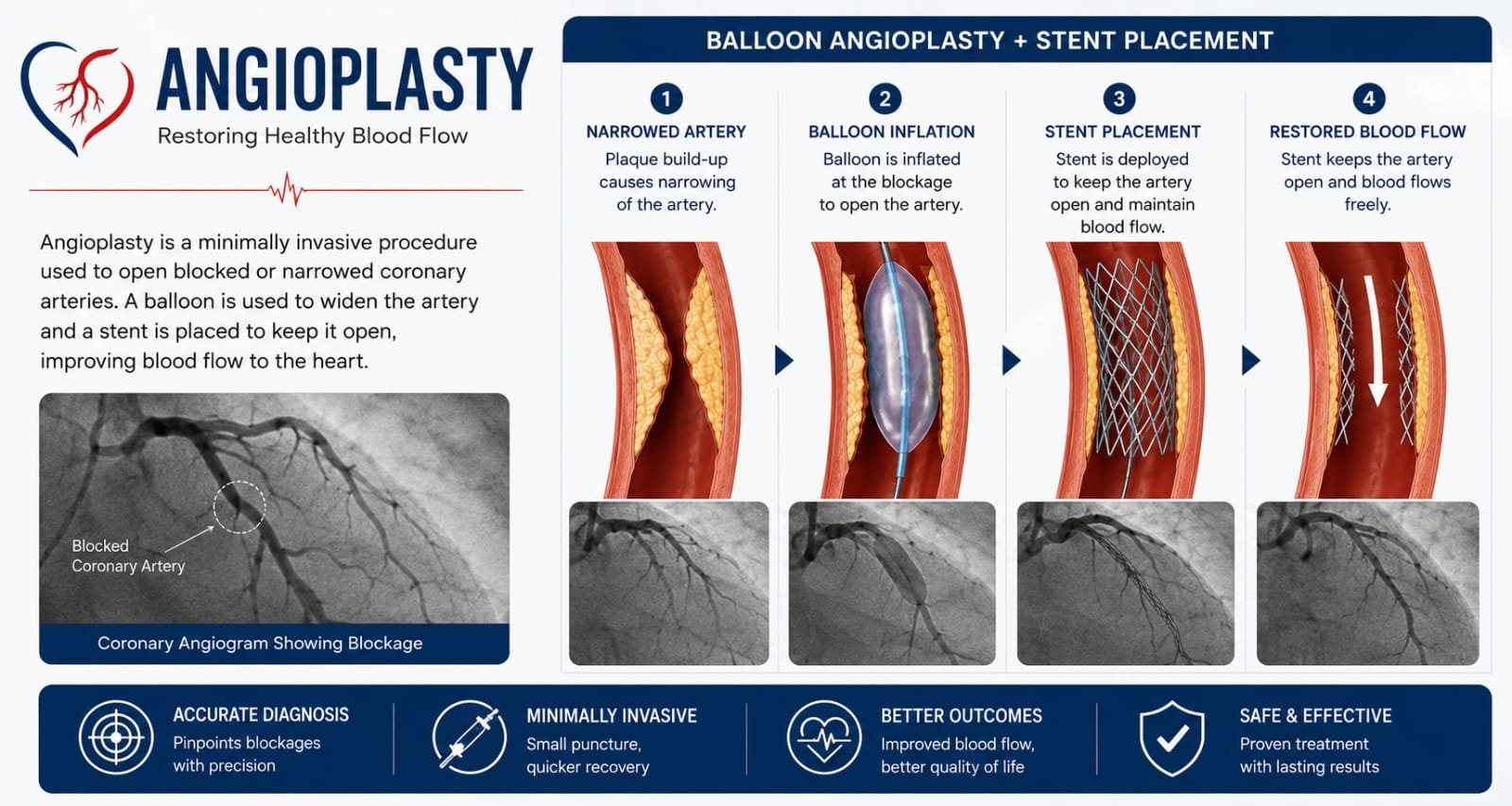
During the procedure, a thin tube called a catheter is guided through a blood vessel — usually from the wrist or, less commonly now, from the groin — up to the blocked part of the artery. A small balloon at the tip of the catheter is inflated to push the plaque outward and widen the artery. In almost all cases today, a stent — a small mesh tube — is left behind to hold the artery open. This is why the full procedure is usually called “coronary angioplasty and stenting,” even though people just say “angioplasty.”
It is done under local anaesthesia, meaning you’re awake through it, and it’s performed in a cardiac catheterization lab, not an operating theatre.
When Is Angioplasty Recommended?
Angioplasty isn’t the first response to every blockage. A cardiologist weighs it against medication and, in some cases, bypass surgery, depending on how many arteries are affected, where the blockage is, and the patient’s overall heart function. Broadly, it’s considered in situations such as:
- During a heart attack (STEMI or NSTEMI) — this is the most urgent scenario. A blocked artery starving the heart muscle of blood needs to be opened as fast as possible, and angioplasty is usually the fastest way to do that.
- Stable angina that isn’t controlled with medication — recurring chest pain or breathlessness on exertion despite optimal medical therapy.
- A significant blockage found on angiography — when a diagnostic angiogram shows a blockage severe enough (typically 70% or more in a major artery, though this varies by case) to be limiting blood flow.
- Certain post-bypass or post-stent situations — where a graft or an earlier stent has narrowed again.
The decision is never made off a single number. It’s based on the angiogram findings, symptoms, ECG changes, and sometimes additional tests like an FFR (fractional flow reserve) that measure how much the blockage is actually restricting blood flow.
How the Procedure Works — Step by Step
- Access point: A small puncture is made, most often in the wrist (radial approach), which has largely replaced the groin (femoral) approach because it’s more comfortable and lets patients get up and walk sooner.
- Guiding the catheter: Using X-ray guidance (fluoroscopy), the catheter is threaded through the blood vessel up to the coronary artery.
- Locating the blockage: A contrast dye is injected so the blockage shows up clearly on the screen.
- Balloon inflation: A guidewire crosses the blockage, and a balloon catheter is inflated at the narrowed spot to compress the plaque against the artery wall.
- Stent placement: A stent mounted on the balloon is positioned and expanded to keep the artery open permanently.
- Checking the result: A final dye injection confirms blood flow has improved before the catheter is withdrawn.
Most angioplasties take somewhere between 30 minutes and 2 hours, depending on how many blockages are being treated and how complex they are.
Types of Stents Used
- Drug-eluting stents (DES): Coated with medication that’s released slowly to reduce the chance of the artery narrowing again (restenosis). These are the most commonly used stents today.
- Bare-metal stents (BMS): Used less often now, mainly in specific situations where a shorter course of blood-thinning medication is needed afterward.
Which stent is used depends on the size and location of the artery, the patient’s bleeding risk, and how long they can safely stay on dual antiplatelet medication after the procedure.
Recovery After Angioplasty
Recovery is faster than most people expect, especially compared to bypass surgery.
- Hospital stay: Typically 1–2 days for a planned (elective) angioplasty; longer if it was done during a heart attack or if there were complications.
- Getting back to routine activity: Most patients can resume light activity within a few days and normal work within a week to ten days, though this depends on the type of work and how the heart muscle itself was affected.
- Wrist or groin site care: Some bruising or a small lump at the puncture site is common and usually settles within a couple of weeks.
- Medication: Dual antiplatelet therapy (usually aspirin plus a second blood thinner such as clopidogrel or ticagrelor) is prescribed for a period your cardiologist decides based on the stent type and your individual risk — this is not something to stop or skip without medical advice, as doing so raises the risk of a clot forming inside the stent.
- Follow-up: Regular check-ups, an echocardiogram if needed, and monitoring of cholesterol, blood pressure, and diabetes control, since these are what caused the blockage in the first place and managing them well protects the other arteries too.
Risks and Possible Complications
Angioplasty is a well-established procedure with a strong safety record when performed by trained interventional cardiologists, but like any procedure done inside the heart’s blood vessels, it isn’t risk-free. Possible complications include bleeding or bruising at the access site, an allergic reaction to the contrast dye, a small risk of the artery re-narrowing over time (restenosis) or a clot forming within the stent (stent thrombosis), and rare but serious risks such as damage to the artery, heart attack, or stroke during the procedure. Your cardiologist will go through your specific risk profile — based on age, kidney function, diabetes, and the complexity of the blockage — before the procedure.
Angioplasty vs Bypass Surgery — What's the Difference?
This is one of the most common questions patients ask once they hear both terms.
Angioplasty | Bypass Surgery (CABG) | |
Type of procedure | Catheter-based, no cutting of the chest | Open-heart surgery |
Anaesthesia | Local (awake) | General (asleep) |
Recovery time | Days | Several weeks |
Best suited for | Single or fewer blockages, accessible locations | Multiple, complex, or diffuse blockages, especially with reduced heart function |
Neither option is universally “better” — the right choice depends on how many arteries are blocked, where, how severely, and the patient’s overall health. This decision is typically made jointly by an interventional cardiologist and a cardiac surgeon (often referred to as a “Heart Team” approach in complex cases).
Angioplasty Cost in Dehradun
Angioplasty cost varies depending on the number of stents used, the type of stent (drug-eluting vs bare-metal), the hospital, room category, and any complications during the procedure. As a general range across India, coronary angioplasty typically costs between ₹1.3 lakh and ₹4 lakh or more, with the number of stents being the single biggest factor. For an accurate estimate based on your specific case, it’s best to discuss this directly during consultation, once the angiogram findings are known. Angioplasty is covered under most health insurance policies and select government health schemes — bring your policy details to your first visit so this can be checked in advance.
Frequently Asked Questions
What is angioplasty and when is it needed?
Angioplasty is a procedure to open a narrowed or blocked heart artery using a balloon and, almost always, a stent. It’s needed when a blockage is significantly restricting blood flow to the heart muscle, whether found during a heart attack or through planned tests for chest pain or breathlessness.
What is the difference between angioplasty and bypass surgery?
Angioplasty is done through a catheter without opening the chest and has a much shorter recovery. Bypass surgery is open-heart surgery, generally used when blockages are more extensive or complex. The choice depends on individual angiogram findings.
How long does an angioplasty procedure take?
Usually between 30 minutes and 2 hours, depending on the number and complexity of blockages being treated.
Is angioplasty a major surgery? Is it painful?
It’s not open surgery — it’s a catheter-based procedure done under local anaesthesia. Patients are awake but shouldn’t feel significant pain; there may be mild pressure or discomfort at the access site.
What is a stent, and what types are used?
A stent is a small mesh tube placed to keep the artery open after the balloon widens it. Drug-eluting stents, coated with medication to reduce re-narrowing, are the most commonly used type today; bare-metal stents are used in select cases.
How much does angioplasty cost in Dehradun?
Cost mainly depends on the number and type of stents used and the hospital’s room category. It’s best discussed after the angiogram, once the exact requirement is known.
What is the recovery time after angioplasty? When can I return to work?
Hospital stay is usually 1–2 days for a planned procedure. Most people resume light activity within a few days and normal work within a week to ten days, depending on their job and overall heart condition.
What are the risks or complications of angioplasty?
Possible risks include bleeding at the access site, contrast dye reactions, artery re-narrowing over time, or, rarely, a clot forming in the stent. Serious complications are uncommon with an experienced team but are discussed individually before the procedure.
Can a blocked artery re-narrow after a stent (restenosis)?
It can, though modern drug-eluting stents have significantly reduced this risk compared to older stents. This is one reason follow-up visits and medication compliance matter.
What precautions and medicines are needed after angioplasty?
Blood-thinning medication (dual antiplatelet therapy) is typically prescribed for a set period and should not be stopped without medical advice. Managing cholesterol, blood pressure, diabetes, diet, and physical activity is equally important for long-term results.
Is angioplasty done through the wrist or the groin?
Both approaches are used; the wrist (radial) approach is now preferred in most cases because it’s more comfortable and allows quicker mobility afterward. The choice depends on individual anatomy and clinical judgment.
Is angioplasty covered by insurance?
It’s covered under most standard health insurance policies and select government schemes, though coverage details vary by insurer and policy. It’s worth confirming your specific coverage before the procedure.