
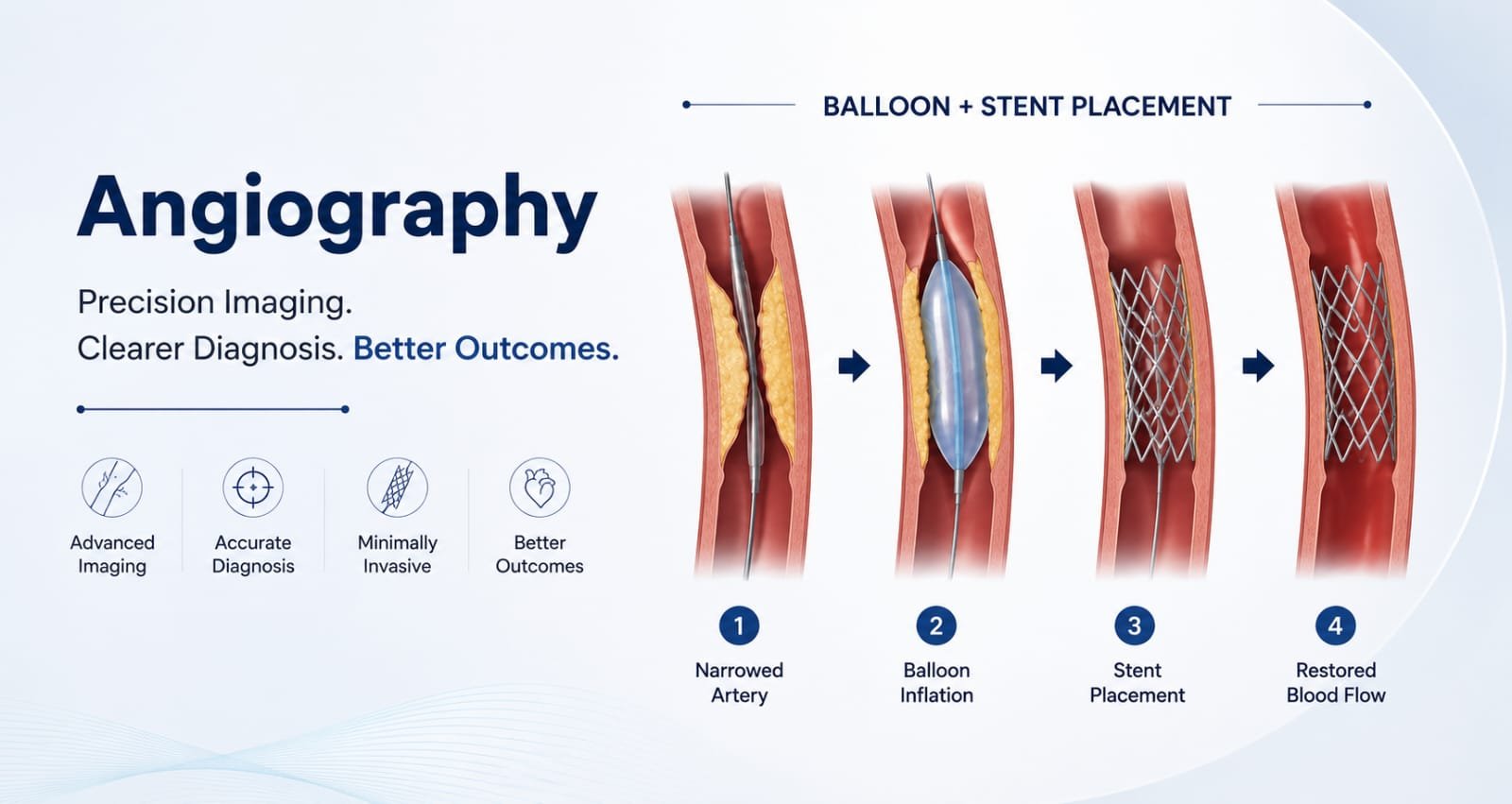
Angiography in Dehradun
If your doctor has recommended an angiography, the first question most people have isn’t medical — it’s “is this the same as angioplasty?” It isn’t, and knowing the difference before your appointment makes the whole process a lot less confusing. This page walks through what angiography actually checks for, how the test is done, what the results mean, and what usually happens next.
Dr. Richa Sharma is an Interventional Cardiologist practicing in Dehradun, performing angiography as part of both routine cardiac evaluation and emergency heart care.
What Is Angiography?
Angiography, also called a coronary angiogram, is a diagnostic test used to see the inside of the heart’s blood vessels. It shows whether any of the coronary arteries — the vessels that supply blood to the heart muscle itself — are narrowed or blocked, and if so, exactly where and how severely.
A thin catheter is passed through a blood vessel (usually from the wrist) up to the heart, and a contrast dye is injected. This dye shows up clearly on a live X-ray, letting the cardiologist see the blood flow through each artery in real time. It’s this imaging that a cardiologist reads to decide whether medication alone is enough, or whether a procedure like angioplasty or bypass surgery is needed.
Angiography is a diagnostic test — it doesn’t treat the blockage itself. Treatment, if required, is a separate decision made based on what the angiography shows.
Why Would a Doctor Recommend Angiography?
An angiography is usually advised when there’s reason to suspect a coronary artery blockage, based on symptoms or earlier test results. Common reasons include:
- Chest pain or angina that isn’t clearly explained, especially if it occurs on exertion and eases with rest.
- Abnormal findings on non-invasive tests — such as an ECG, a TMT (treadmill test), or a stress echocardiogram — that suggest reduced blood flow to part of the heart.
- During a heart attack — angiography is done urgently to locate the blocked artery so it can be treated immediately, usually with angioplasty in the same sitting.
- Unexplained breathlessness or reduced heart function where a blockage is one of the possibilities being ruled out.
- Follow-up after a previous stent or bypass, if symptoms return and re-narrowing is suspected.
It’s worth noting that angiography is generally recommended after initial, less invasive tests point toward a likely blockage — it isn’t usually the very first test done for chest pain.
How the Procedure Works
- Access point: A small puncture is made, most commonly at the wrist (radial approach), sometimes at the groin (femoral approach), depending on the patient’s blood vessels and clinical situation.
- Local anaesthesia: The area is numbed; you’re awake throughout the procedure.
- Catheter placement: A thin catheter is guided through the blood vessel to the opening of the coronary arteries, under continuous X-ray guidance.
- Dye injection: Contrast dye is released into each artery in turn, and images are recorded as it flows through, highlighting any narrowing or blockage.
- Reviewing the images: The cardiologist examines the images immediately to assess the extent and location of any blockage.
- Closure: The catheter is removed and pressure is applied to the puncture site, or a small closure device is used, to prevent bleeding.
The procedure itself usually takes 20 to 45 minutes, though the total time at the hospital, including preparation and post-procedure monitoring, is longer.
How to Prepare for Angiography
- You’ll usually be asked to fast for 6–8 hours before the procedure.
- Bring a list of your current medications — some, particularly certain diabetes medications and blood thinners, may need to be adjusted beforehand under your doctor’s guidance.
- Basic blood tests (including kidney function) are usually done beforehand, since the contrast dye is processed by the kidneys.
- Let your doctor know about any known allergies, particularly to contrast dye or iodine, and about any prior kidney problems.
- Arrange for someone to accompany you and drive you home afterward, especially if a sedative is used.
What Happens After Angiography
Most patients are monitored for a few hours and can go home the same day if no further procedure is needed and there are no complications. If the wrist was used, a compression band is applied for a few hours; if the groin was used, a longer period of lying flat is usually advised. Mild bruising at the site is common and settles on its own.
If the angiography shows a significant blockage, your cardiologist will discuss the findings with you directly — the images make it possible to explain exactly where the blockage is and what the options are, whether that’s continuing on medication, proceeding with angioplasty and stenting, or a referral for bypass surgery in more complex cases. In an emergency setting, such as during a heart attack, angioplasty is often performed immediately after the diagnostic angiography, in the same sitting.
Angiography vs Angioplasty — What's the Difference?
This is the single most common source of confusion, so it’s worth stating plainly:
Angiography | Angioplasty | |
Purpose | Diagnostic — looks for blockages | Treatment — opens a confirmed blockage |
What happens | Dye injected, images taken | Balloon and stent used to widen the artery |
Duration | 20–45 minutes | 30 minutes–2 hours |
Always leads to treatment? | No — many angiographies show no significant blockage, or one manageable with medication | By definition, this is the treatment step |
In short: angiography looks, angioplasty acts. Many patients undergo angiography and need nothing further beyond medication and lifestyle changes.
CT Angiography vs Conventional (Catheter) Angiography
Patients sometimes come in having already had a CT angiography, which is a non-invasive scan (no catheter, just an IV contrast injection and a CT machine) that gives a good picture of the arteries and is useful as a screening or early diagnostic step. Conventional angiography, done via catheter as described above, gives a more detailed, real-time view and is the only one that allows treatment (like angioplasty) to be done in the same sitting if needed. Your cardiologist will advise which is appropriate based on your symptoms, risk factors, and prior test results.
Angiography Cost in Dehradun
Angiography cost depends on the hospital, room category, and whether it’s a planned procedure or done urgently. As a general range across India, coronary angiography typically costs between ₹15,000 and ₹40,000. This is separate from the cost of any treatment, such as angioplasty, that may follow if a blockage is found. For an accurate estimate for your situation, this is best discussed directly during consultation. Angiography is covered under most standard health insurance policies — bring your policy details to your first visit so this can be checked in advance.
Frequently Asked Questions
What is angiography / a coronary angiogram?
It’s a diagnostic test that uses a catheter and contrast dye to show whether the heart’s arteries are narrowed or blocked, and where. It’s the standard way cardiologists confirm and locate a coronary blockage.
What is the difference between angiography and angioplasty?
Angiography is diagnostic — it shows whether a blockage exists. Angioplasty is the treatment that opens a confirmed blockage using a balloon and stent. Angiography doesn’t always lead to angioplasty; many patients need only medication after the results.
Why has my doctor advised an angiography?
Usually because of symptoms like chest pain or breathlessness, or because an earlier test (ECG, TMT, stress echo) suggested reduced blood flow to part of the heart that needs a closer look.
How is angiography done, and how long does it take?
A catheter is passed through a blood vessel, usually from the wrist, and contrast dye is injected to image the coronary arteries on X-ray. The procedure itself typically takes 20–45 minutes.
Is angiography painful or risky?
It’s done under local anaesthesia, so significant pain isn’t expected, though there may be mild discomfort at the access site. It’s a well-established procedure, though like any catheter-based test it carries some risk, which your cardiologist will discuss based on your individual profile.
How much does angiography cost in Dehradun?
It generally falls in the ₹15,000–₹40,000 range depending on the hospital and circumstances, though this is best confirmed for your specific case during consultation.
Can angioplasty be done at the same time as angiography?
Yes, if a significant blockage is found and the clinical situation calls for immediate treatment — this is common during a heart attack. In planned, non-emergency cases, it’s often done as a separate, scheduled procedure after discussing the findings.
What is the difference between CT angiography and conventional angiography?
CT angiography is a non-invasive scan using a CT machine and IV contrast, often used as an initial screening step. Conventional (catheter) angiography is more detailed and is the only one that allows treatment like angioplasty in the same sitting.
How should I prepare for an angiography?
Fasting for 6–8 hours beforehand, informing your doctor of all current medications and known allergies, and having basic blood tests done in advance are the usual requirements.
How long is the recovery / hospital stay after angiography?
Most patients go home the same day if no further procedure is needed, after a few hours of monitoring. Mild bruising at the puncture site is common and resolves on its own within days.
What do the results of an angiogram mean?
The report will describe which arteries were examined and whether any blockages were found, often described as single, double, or triple-vessel disease depending on how many major arteries are affected. Your cardiologist will explain what your specific result means for treatment.
Is angiography safe for diabetic or kidney patients?
It can be done safely in most cases, but kidney function is checked beforehand because the contrast dye is processed by the kidneys, and precautions are taken for patients with diabetes or existing kidney concerns. This is assessed individually before the procedure.